
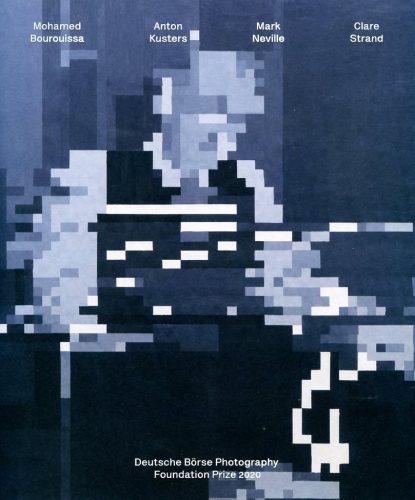
Deutsche Borse Photography Prize 2020 - Bourouissa, Kusters, Neville, Strand
Photographers'Gallery, ISBN 9781916348707,
Pb, 128 pgs, 22 x 27cm
Acqn. 30510
Awaiting stock - please contact orders@artdata.co.uk to make preorders
£31.25
Pb, 128 pgs, 22 x 27cm
Acqn. 30510
Awaiting stock - please contact orders@artdata.co.uk to make preorders
£31.25
The Deutsche Borse Photography Foundation Prize is an annual award, originated by The Photographers' Gallery, to recognise and support the most innovative, original and relevant photography-based practice within a given year.
Questioning the circulation of knowledge, social control and power dynamics in contemporary French society, Mohamed Bourouissa focusses on disenfranchised people and communities. Working across photography, video and sculpture, his work probes socio-economic processes, and the invisible tensions between different social milieus and their related culturally and historically prescribed representations.
Questioning the act of commemoration and its potentially limited means of representing grief and suffering, Anton Kusters proposes other ways of seeing and dealing with such history. The installation also features a 13 year-long generative audio piece by sound artist, composer and songwriter, Ruben Samama, which represents, in both sound and duration, the period between 1933 and 1945 when the camps were active, and further signifies the human loss at each of the sites.
Mark Neville began taking photographs in Guingamp, Brittany ("little Britain") in 2016 and over three years, produced a complex, multi-layered portrait of this tight-knit provincial farming region. Connecting art and social documentary practices, he further photographed different agribusinesses in the community - from small holdings to large industries. The resulting photobook, now accompanied by a publication of essays by Brittany farmers articulating the need for a sustainable, humane, even ecotopian type of agriculture, was sent out to UK and European ministries of agriculture and food as well as key policy makers, calling for the urgent adoption of more ecological methods of farming.
Clare Strand was Inspired by George H. Eckhardt's publication Electronic Television (1936) and adopts this methodology as a way of exploring the process of transmission and reception, recreating existing photographic images into paintings via encoded messages by telephone. The project features photographs (information sources) and paintings (information destinations) also reflecting the competitive and often problematic relationship between the two media.