
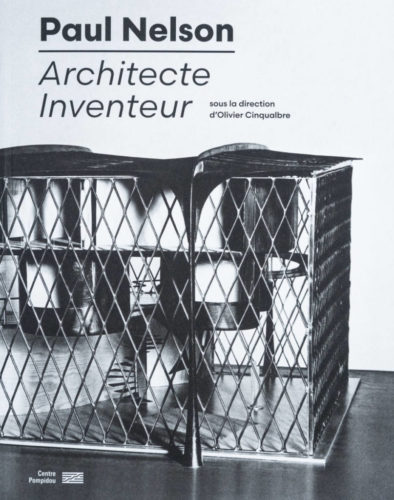
Paul Nelson
Centre Georges Pompidou, ISBN 9782844269041,
Pb, 144 pgs, 22 x 28cm
Language: French
Acqn. 31843
Awaiting stock - please contact orders@artdata.co.uk to make preorders
£31.95
Pb, 144 pgs, 22 x 28cm
Language: French
Acqn. 31843
Awaiting stock - please contact orders@artdata.co.uk to make preorders
£31.95
Paul Nelson, an architect of American origin, born in Chicago in 1895 and died in Marseille in 1979, belongs to the category of architects rarely mentioned in the classics of the history of modern architecture.
After studying at Princeton, Nelson discovered France as a volunteer aviator on the Allied front during the First World War. In 1920, he began studying architecture at the Ecole des Beaux-Arts in Paris, first in the Pontremoli workshop, then in the Perret workshop known as the Palais de Bois workshop. He graduated in 1927 and stayed in France until 1940. His dual affiliation explains why he was considered an American architect in France and conversely as a French architect in the United States.
Particularly interested in the question of prefabrication and a specialist in hospital architecture, he distinguished himself by his participation in reconstruction in France after the Second World War. He designed the new Saint-Lo hospital, for which he brought in Fernand Leger and Charlotte Perriand, and other hospital and experimental projects. His prototype of a "hanging house", the archives of which are kept at the National Museum of Modern Art, is the mark of an extraordinary creator.