
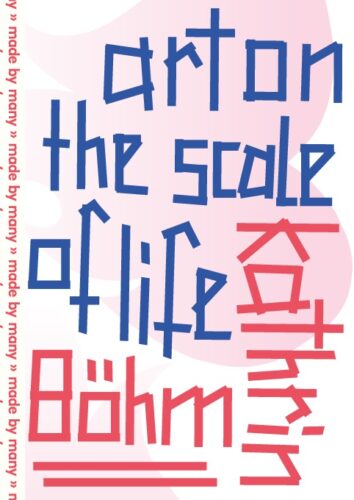
Kathrin Bohm - Art on the Scale of Life
Paul O'Neill Gerrie van Noord
Sternberg Press, ISBN 9783956796265,
Pb, 340 pgs, 17 x 24cm
Acqn. 33410
In Stock
£22.50
Pb, 340 pgs, 17 x 24cm
Acqn. 33410
In Stock
£22.50
This volume critically profiles, contextualizes, and theoretically elaborates the unique practice of the UK-based German artist Kathrin Bohm. Combining visual and textual material, it offers an overview of Bohm's exceptional modus operandi that is rooted in a highly original artistic synthesis of a range of practices. Over the last three decades, Bohm has expanded the terms of socially engaged ways of working to an unprecedented scale and breadth by producing complex organizational, spatial, visual, and economic forms. These often entail the production of complex infrastructures, manifested via projects such as Culture is a Verb (2018-21), The Centre for Plausible Economies (2018-ongoing), Company: Movements, Deals and Drinks (2014-ongoing) and the Eco-Nomadic School (2010-ongoing). The book follows a major mid-career exhibition at The Showroom, London, in 2021.
Offering a significant addition to debates on contemporary art and architecture, social action, and public culture, Kathrin Bohm: Art on the Scale of Life brings together critical reflections by internationally acclaimed contributors. Spanning a wide range of critical positions and disciplines, these include Dave Beech, Celine Condorelli, Elvira Dyangani Ose, Wapke Feenstra, Katherine Gibson, Joon-Lynn Goh, Lily Hall, Yolande Zola Zoli van der Heide, Grace Ndiritu, Gerrie van Noord, Paul O'Neill, Doina Petrescu, Gregory Sholette and THEMM!!, Kuba Szreder, Gavin Wade, Mick Wilson, Stephen Wright, and Franciska Zolyom. In addition, material derived from Bohm's international networks and projects provides an in-depth impression of the deeply ingrained collaborative and durational nature of her way of working.
Photographic, diagrammatic, and typographical imagery runs through the book, demonstrating the rich visual and spatial languages embedded in Bohm's work. This visual register of the book is therefore much more than a series of illustrations and acts as a counterpoint to, and extension of, the ideas elaborated in the texts.